
← Newsroom2020.04.27
An air taxi for the city
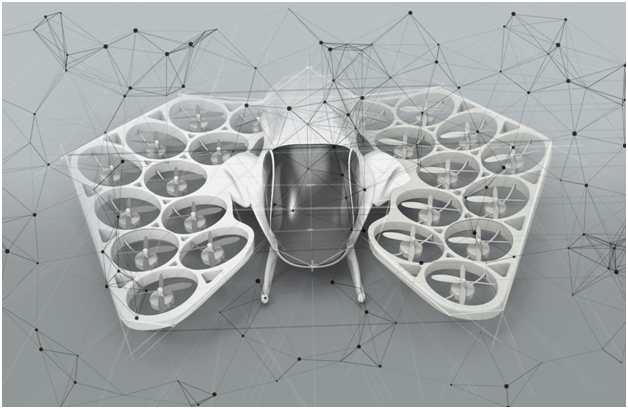
Flyka on the unmanned air taxi market.
This year has seen a sharp surge of interest in flying cars and air taxis. The reasons: a number of countries have announced work on a legal framework for this kind of transport, several developers - including major players - have stepped out of the shadows, and adjacent fields such as electric vehicles and alternative energy are booming, advancing the very technologies this sector depends on: high-capacity batteries and efficient electric motors.
It is also worth remembering that general aviation accounts for 89% of all civil aircraft, that 87% of all flights are made by general aviation, and that flying cars and air taxis fall precisely into this category. In the United States alone, this industry contributes $4 billion in annual tax revenue and turns over $50 billion a year, with steady growth. It is a large and fairly conservative market, so it is no surprise that the arrival of a new kind of aircraft has stirred it into life.
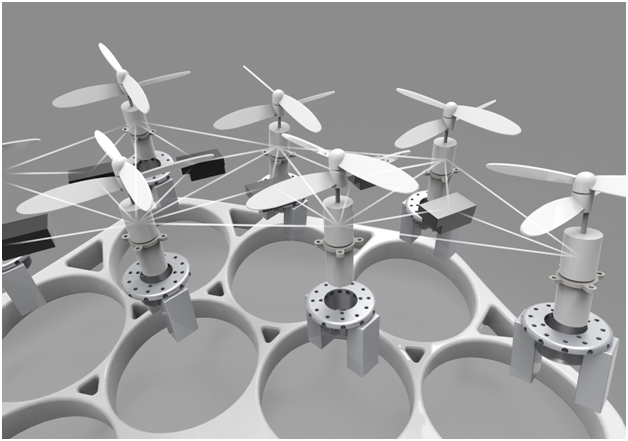
Flyka is developing a safe urban air taxi built on a distributed architecture - a swarm of self-sufficient motor units that make the aircraft resistant to failures of motors, batteries and systems, and even to onboard fires, while keeping its cost to the operator profitable and below that of a helicopter. In this article I will try to explain why this particular architecture was chosen, how our company sees the future of the market, and why a large share of today's projects in this field will lose out to aircraft and helicopters that already exist.
Markets.
Whenever you start any development effort, you always ask yourself two questions:
a) which market are you targeting?
b) why will the user prefer your solution to the ones that already exist?
The thing is, the problem of carrying a person through the air was solved long ago. There are light helicopters, medium and heavy helicopters, light aircraft and airliners. The task of carrying a person any distance by air is already handled by existing means. So what exactly is the problem?
The problem is cost and safety. An air taxi in New York will cost you 500 to 2,000 dollars. In Russia the price will be the same, because the savings on a pilot's salary are cancelled out by import duties on the helicopter and its parts (light helicopters are not mass-produced in our country). At such prices the service cannot become a mass one.
Why develop a new kind of aircraft?
Because making air travel cheaper on existing types is impossible.
All of modern aviation follows the path of improving component quality, thereby raising flight safety and... the cost of the machines. At fixed intervals, aircraft undergo scheduled maintenance by "forms". For the Mi-171, for example, forms are prescribed every 25, 50, 100 and so on flight hours. Depending on the form, the work ranges from an external inspection of the machine to the disassembly and fault-checking of its units. Fault-checking is done on special equipment by specially trained people in licensed companies. These people take annual refresher courses and, together with their companies, renew their licenses. Other people - the manufacturer's representatives - extend service lives and take part in clearing the equipment for operation. There are those who issue licenses and those who issue licenses to them. It is a vast anthill of thousands of people, each of whom draws a salary while the organizations draw a profit. And this money comes out of the cost of a flight hour. The only way to cut the flight-hour cost is to simplify maintenance.
The second cost item is the pilot. He has to be trained, he has to be paid, and, again, his pilot's license has to be renewed.
The third item is the dispatch service, which has to coordinate the pilots' work in the cramped space of a city.
Why a multirotor?
The multirotor architecture makes it possible to answer the question of why the user will prefer your solution - namely, through flight safety (provided the multirotor is designed correctly).
The thing is, a damaged airplane can land by gliding and a helicopter by autorotation. But in a big city there is no room for such a landing. To descend by parachute you need, at the very least, to stabilize the falling craft. If the craft is spinning - for instance from an impulse caused by a non-simultaneous failure of its propulsors - it will simply tangle itself in the lines. And even if the craft is stabilized and the parachute has managed to open and fill, where is it to fall in a big city? Onto a motorway, into a courtyard full of children and cars, into the river? Passengers are unlikely to enjoy such a ride either.
The multirotor architecture appeared before the single-rotor one. In the days of the first helicopters by Cheryomukhin and Corradino d'Ascanio, it was precisely the single-rotor layout that was considered a dead end, and aviation exhibitions were full of multicopters (the Breguet-Richet Gyroplane, the de Bothezat helicopter, the Cornu helicopter and so on). The multirotor is more technologically sound and more logical, which is why it was invented earlier and enjoyed such popularity. But it was hard to control a multirotor. That problem no longer exists. Automatic control systems have long been cheaper than mechanical ones. Fighter jets have for many years been built to aerodynamically unstable layouts, and airliners are flown by autopilot for most of a flight - with automatic separation via TCAS on top of that.
There are three ways to improve an aircraft's safety:
§ increase the reliability of individual elements;
§ reduce the number of critical elements;
§ make the system distributed, with elements redundantly duplicated many times over.
A multirotor satisfies all three paths at once: the absence of the mechanical control elements inherent to helicopters (each of which is a point of potential failure) increases reliability and simplifies maintenance (modular replacement of standard elements), and it also simplifies autopilot integration (there is no need to install extra servos, which are themselves a source of failures). Because the mechanical side is so simple, the problem of increasing element reliability shifts to the electronic side, which is cheaper and easier to make redundant.
Redundancy fits this architecture perfectly, because the main element - the propulsor - is already distributed. The degree of redundancy matters. A quadcopter falls if any one propulsor fails, but too many rotors degrade the system's efficiency. The optimal number of propulsors is easily calculated mathematically from the required reliability and the failure model of each rotor.
And do not forget the battery. It does not matter how many propulsors you have if they are all powered centrally from a single battery or controlled by a single autopilot board over a single cable. In our project each motor unit has its own battery, suspended beneath its own motor. This not only isolates any failure (including fire) inside a motor unit and rules out dependent and cascading failures, but also takes the battery mass off the fuselage and lets us make it lighter. Since the start of 2020 two electric aircraft have already caught fire - the Alice and the Lilium - and earlier the Boeing 787 had problems with lithium batteries igniting.
In our view, a battery placed close to the passenger dooms any aircraft project. There are already plenty of dangers in flight - why also booby-trap the cabin yourself? And in a hard landing, are you really sure it will not go off under the tourist's seat?
Why an autopilot?
The autopilot is able to remove both the pilot and the dispatcher from the system.
Indeed, a rooftop-to-rooftop shuttle flight is quite predictable and easy to compute. There is no need to keep a qualified pilot on board for a 15-minute hop.
Dispatching and separating craft in the air is handled far more effectively by automated control systems. No artificial intelligence, machine vision or blockchains are needed. Mobile or radio communication, position and speed data, and a single trajectory-analysis server will sort the craft into flight levels using vector algebra. If several mobile carriers and satellite positioning systems are used at once (redundancy again), the chance of losing communication is minimal. An urban air taxi is not required to operate under nuclear war with all communication systems down - and in any case even the simplest TCAS can be implemented on a modern component base without much expense.
Why electric?
In the rooftop-to-rooftop shuttle concept, the question of delivering and storing fuel becomes acute. Storing tonnes of fuels and lubricants on a rooftop exposed to lightning and static electricity is reckless, and arranging fuel delivery is harder still - carrying it up in canisters in a lift is hardly possible, since lift operating rules forbid it. A separate breed of flying tankers and a refuelling service would have to be created, and that would drive up the cost of transport and complicate the system. Nor should we forget urban ecology: emissions from air taxis would be significant, and a tanker crashing from the sky would cause colossal damage.
At the same time, electric propulsion already provides enough flight time for intra-city hops today, and the charging time of a distributed (and therefore well-cooled) power system is measured in minutes. The necessary electrical capacity is already available in buildings. An electric propulsor is simpler in design, which makes it possible to build distributed systems with a smaller increase in cost and maintenance complexity than internal combustion engines would bring. If you fix the cruising speed of an urban air taxi and thereby abandon a variable-pitch rotor system, then in the entire propulsion unit only a single bearing - with a service life of 6,000 hours - will wear out.
Tellingly, until the mid-2000s the market for radio-controlled models, especially flying ones, was very much a niche. To play with an airplane for 10 minutes you had to fill the tank with toxic fuel subject to regulation, heat up the glow plugs, and start the engine with a hand-held electric starter or with your fingers (at the risk of losing them). And in a crash you faced a long, expensive model repair. With the arrival of affordable lithium batteries and electric motors, the market took a leap. The cost of models fell and their variety multiplied many times over; they flooded the shelves, and multicopters that had been unthinkable before appeared. It was precisely the switch to electric power and the reduction in the hassle of ownership that produced this result.
Ask yourself: would you buy a selfie copter that you had to fuel with methanol and start with a flick of your finger?
Why not a tiltrotor?
Many of the projects presented by developer companies are built to a tiltrotor layout. To understand the problems of this layout, let us turn to the notion of propeller efficiency. Efficiency is higher the larger the propeller diameter and the lower its rotation speed. That is exactly why helicopters are the way they are. The price paid for this efficiency is a limit on the helicopter's top speed, caused by flow separation from the fairly slow blade moving against the helicopter's direction of travel - relative to the air, its speed and lift approach zero.
Airplane propellers, by contrast, are small in diameter and high-revving. This is a necessary sacrifice for speed - choking (or the "wave crisis") occurs in a fast propeller at higher speed.
Now let us look at the tiltrotor. Take, for example, the famous Bell V-22 Osprey (though even the Yak-38 can be considered a tiltrotor of sorts). It is obvious that its rotors are a compromise between a helicopter rotor (to provide acceptable thrust and efficiency in a hover) and an airplane propeller (to provide acceptable speed in horizontal flight).
Let us also turn to the notion of power-to-weight ratio - the ratio of propulsion power to the aircraft's mass. It is measured in watts per kilogram, or in units of thrust: for vertical-takeoff-and-landing craft the thrust must be above 1 (exceeding the craft's mass), whereas for airplanes it can be as low as 0.3.
The table below shows three production aircraft, each with a laden takeoff mass of about 22 tonnes - the An-140 airplane, the Bell V-22 tiltrotor, and the Boeing CH-47 helicopter. The table makes it obvious that, to match the An-140's figures, the V-22 tiltrotor must have a far greater power-to-weight ratio, which is spent precisely on overcoming the tiltrotor's aerodynamic non-optimalities. The greater mass of the propulsion unit and auxiliary systems steals internal volume, as can be seen from the passenger capacity.
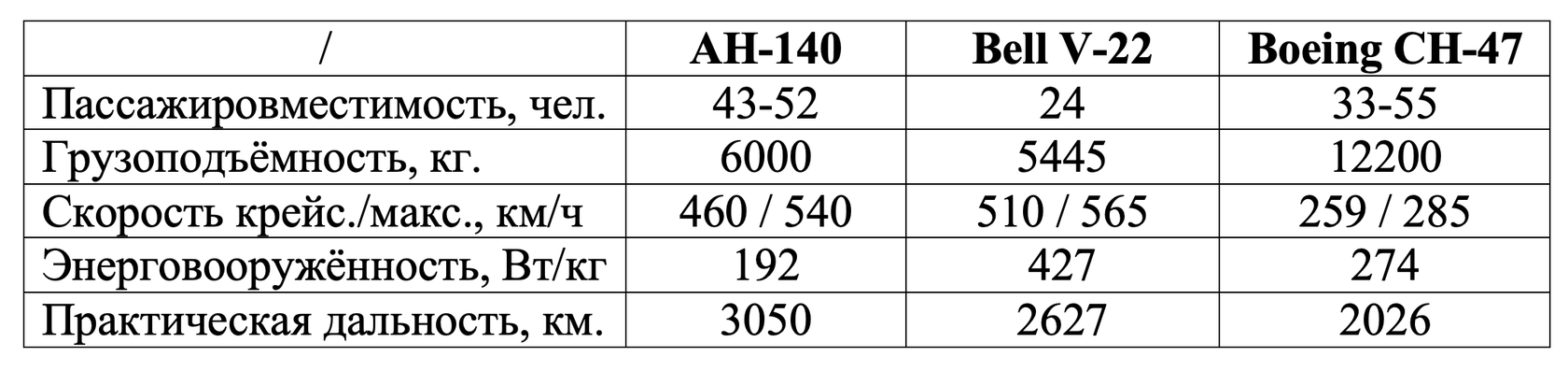
On takeoff a tiltrotor must provide thrust greater than its own mass, while in horizontal flight, when the main load is borne by the wings, the engines can be throttled back to an easy regime - but the excess mass becomes "dead weight" that has to be carried around. A tiltrotor reaches maximum efficiency precisely in horizontal, airplane-like flight, so it is inefficient over short distances. Over long distances it will always lose to an airplane in speed because of the limits imposed by its large, slow rotors.
A tiltrotor is also far more complex technically than a helicopter or an airplane, which raises both the cost of the craft and of its upkeep, and increases the probability of failure through the greater number of flight-critical elements. The number of V-22 accidents speaks eloquently of this vehicle's unreliability.
So what is a tiltrotor good for? For this class of craft there is a narrow niche: when transport has to be carried out with vertical takeoff and landing (or hovering), but at a speed higher than a helicopter can provide. This matters for airborne assault operations, where the speed of getting past enemy air defences is more important than the cost of a flight hour. In the civil sector a tiltrotor could be used for rooftop-to-rooftop intercity travel: over distances of 300 km or more its speed advantage over a helicopter becomes noticeable. But within a city it is more efficiently replaced by a cheaper helicopter.
In place of a conclusion
Unfortunately, building a big quadcopter and giving it a trendy name is not enough. Designs like that cannot answer the question of why you and not Robinson? Worse still, most of them will lose to the production Robinson on the sum of their parameters.
On the other hand, building an urban air taxi by classical canons, focusing only on efficiency and energy consumption, is fundamentally wrong. The main criterion for an urban air taxi must be safety. Look at the cars around you: how energy-efficient are they at carrying one or two people? Why doesn't a Range Rover driver switch to a more efficient moped? Perhaps he has reasons for it that have nothing to do with his engine's efficiency and fuel consumption?
Even though the energy efficiency of a multirotor's propellers is, a priori, lower than that of a single-rotor helicopter or even the simplest 4x1 quadcopter, these craft - given correct system design and a sufficient degree of distribution - are able to provide greater flight safety than existing airliners, while keeping their cost equal to or lower than that of a light helicopter. Maintenance becomes simpler and cheaper: standard blocks can be swapped as whole assemblies by low-skilled personnel, and diagnostics can be automated as in modern cars. Shifting functions from the mechanical to the electronic side of the craft simplifies and cheapens the onboard system.
The lower energy efficiency of a multirotor's propulsor (compared with a helicopter) leads to an increase in energy costs of 48 dollars a day, while the gain from technological improvements reaches 700 dollars a day. Clearly, propulsor efficiency is not the deciding factor in assessing the flight-hour cost of this kind of aircraft.
A large number of propellers is, at first glance, even less efficient than, say, the 4 paired propellers of a 4x2 quadcopter. But if you think about it a little, the gap turns out not to be so large, because a paired propulsor needs at least a 50% power reserve for each motor (of the pair) and its controller, so that at any moment it can compensate for the lost thrust of a failed partner and avoid a crash. This extra reserve mass will be hauled as dead weight on every flight and go unused during it (otherwise the whole point of the reserve is lost). For a craft with a large number of motors (22 in our case) this reserve, needed to compensate for failures, amounts to just 4% per motor. And the efficiency of using the power and mass available in flight turns out to be higher.
The batteries suspended beneath the motors do not load the power frame and fuselage with their mass, and thereby save on their weight. There is also no need to run heavy copper power cables from the battery to the motors out of the centre of the craft - cables whose total onboard mass can reach 80 kg (the estimate was made for the Volocopter based on published drawings and information from patents about the design and parameters of its power system).
In our aircraft the power cable in each motor unit is only 15 cm long, and their total mass is under 1.5 kg. Naturally, our electrical losses in the cable are lower too. Can the greater propeller efficiency of a helicopter or quadcopter make up for an extra 80 kg of copper on board and heating the atmosphere with the cable? And can a single engineering error like this wipe out the entire gain from better aerodynamics?
The answer is obvious.
The multirotor's efficiency is also helped by the physical processes taking place in the pressure field of neighbouring propellers. The experience of flying our prototypes, including with simulated random failures, shows that a multirotor's efficiency is not so far behind an equivalent quadcopter's (the assessment was based on motor current draw and actual flight time per amp-hour), yet it far surpasses it in control precision and stability in flight.
The multirotor architecture also brings greater comfort in flight, because the noise and vibration of the motor units in the cluster largely cancel each other out, and the uniform pressure field created by the cluster of propellers makes the craft more stable in flight - which is also helped by the lower inertia of each small-diameter propeller, needing less time and energy to change its rotation speed and thereby counter an external disturbance.
The batteries placed beneath the motors (below the aircraft's geometric centre), which additionally damp motor vibrations with their mass and are effectively cooled by the airflow from the propellers, improve the craft's resistance to wind disturbances and to overturning. Of course, this comes at the expense of the aircraft's agility - but then, we are not building a fighter jet...
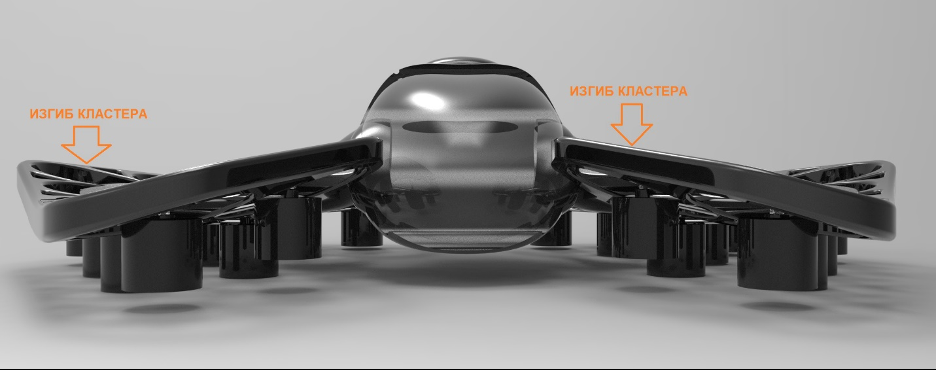
High stability in hover, together with protected motors, gives the craft the ability to approach structures from any side and, for instance, to drop off maintenance personnel. The curved shape of our aircraft's cluster is designed so that, in a hover, the motors are splayed outward and their oppositely directed jets help hold position, just as dynamically positioned vessels and oil platforms do. But tilt the craft forward by 5-7 degrees, imperceptible to the passenger, and the front motors set themselves horizontal while the rear ones turn as much as 15-20 degrees to the direction of flight, producing a pronounced horizontal thrust vector without installing any additional horizontal-thrust motors or any tilting mechanisms, which have comparatively low reliability and high cost and mass.
A problem cannot be solved at the same level on which it arose (c). The advance of technology continually shifts the balances, and what was difficult or unprofitable at the start of the 20th century turns out to be simpler and cheaper at the start of the 21st; a technical solution that is unprofitable and, at first glance, foolish under familiar conditions is capable of bringing about a revolution under new ones.
We believe that correctly designed, ultra-reliable multicopters will form the backbone of the world's urban aircraft fleet in the 21st century.
About the Flyka project
It would be wrong not to tell you what the Flyka team has actually accomplished and what stage the project is at.
From the very beginning we placed our emphasis on developing the onboard systems. We developed our own reliable coaxial motor, our own motor controller and our own autopilot, in strict compliance with the requirements of the DO-series standards (-178, -254, -160 and so on) and the aviation regulations. We see no point in building an aircraft with no prospect of certification or further development just for one successful takeoff on camera.
We derived the optimal aircraft architecture and the structure of the onboard distributed network of motor units mathematically, along with the optimal algorithms for the distributed autopilot and motor controller, and proved on mathematical models and in test flights a high degree of fault tolerance and the absence of cascading and dependent failure scenarios.
The result of this work was the development of our own onboard equipment, as well as a distributed autopilot with an original fault-tolerant flight-control-system algorithm. Flight tests with malicious code that randomly shut down motors without the control system's knowledge showed the ability to withstand 7 failures and more (more - already with a loss of altitude, but with controllability preserved). In parallel we developed a coaxial motor of our own design. Development took 2 years and required building a full-scale test bench with the measurement channels certified by a Rostest metrologist - without which it would have been impossible to bring the motor's parameters up to the required values. In the video above you can see a service-life run of 26 minutes (in fact 40 minutes, but the camera ran out of charge earlier) at 100% throttle under real conditions. This is also the answer to the question: what happens in rain or snow? As you can see, nothing bad happens.
In parallel we studied the operation of a shrouded coaxial propeller and the Bartini effect. We developed an aerodynamic well that delivers a 14% gain in efficiency (in g/W) compared with an open coaxial propeller.
Naturally, a motor controller capable of operating in a distributed network, correctly driving a coaxial motor and, at the same time, being lightweight was not on the market, so it too had to be developed.
Structurally, the project evolved from attempts to place the motors at the front and rear - already implementing full distribution back then - to the current, more refined configuration of side-mounted foldable clusters.
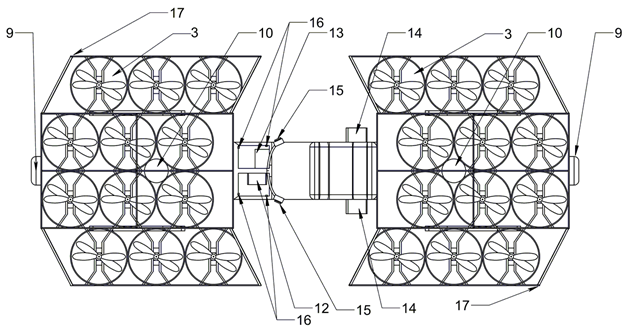
Drawing of the aircraft from the earliest patent
The project has been developing continuously for more than six years, and it does so in full accordance with the scientific method. Every idea or model first undergoes mathematical and then real-world testing, and only then is it included in the project. We have come a long way and laid a solid technological foundation for the company, instead of hastily assembling aircraft mock-ups out of toy parts. We are ready for certification under the most demanding programme - for a passenger aircraft - rather than the experimental-aircraft certificate typical of the industry, which some projects slyly pass off as proof that their product has passed full certification (even though that certificate is issued for absolutely any aircraft - that is what "experimental" means).
Passenger safety always comes first. Deliver the passenger in one piece - at any cost. That is perhaps the best motto for Flyka.